

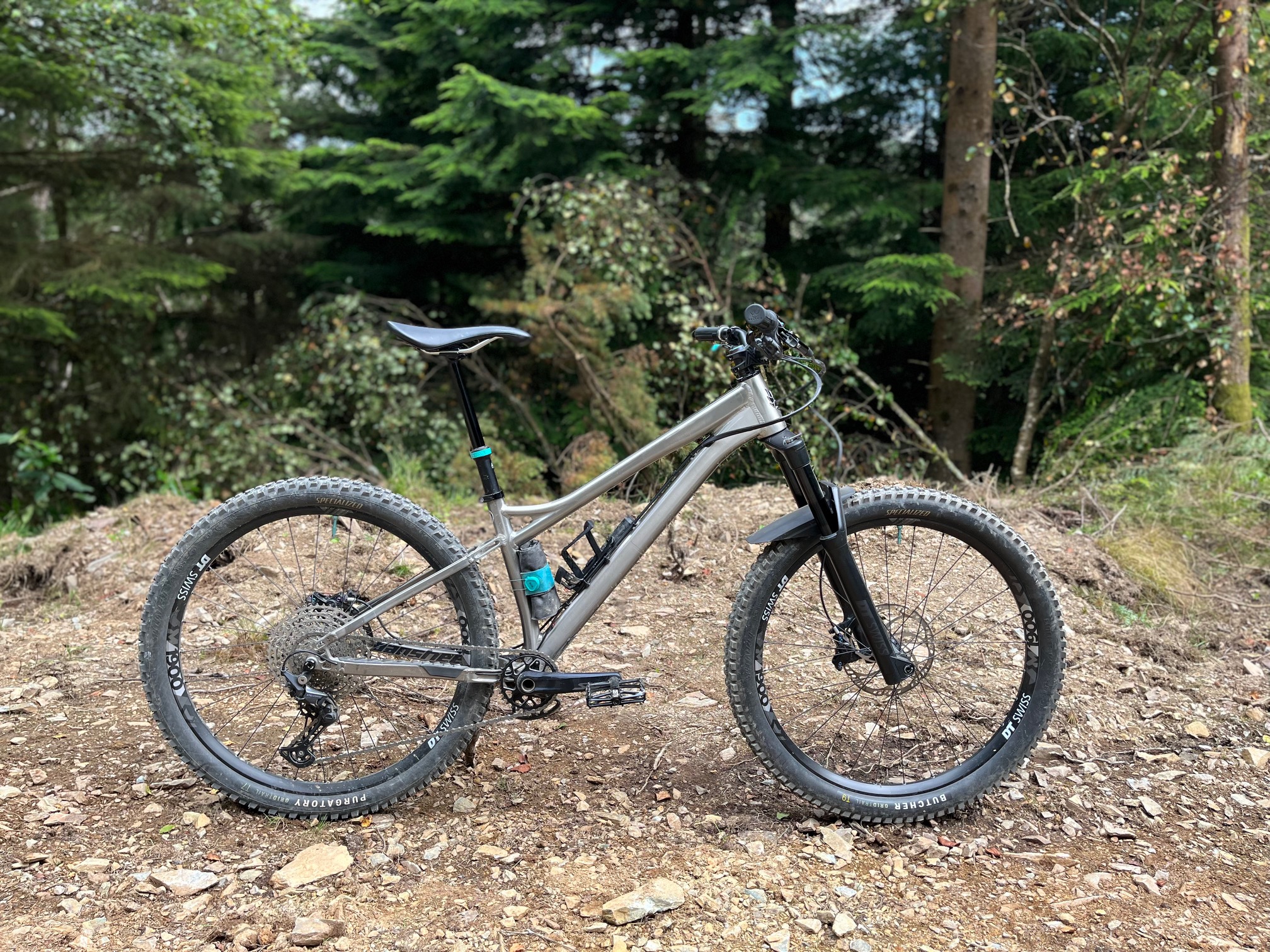
I’m going to open this with a riddle from the 2022 Batman movie. Bear with me here…
“The less of them you have, the more one is worth.”
The year 2024 was a strange one for me. I started off contracting COVID-19 for the third (?) time in late January, and since then I’ve been left dealing with its lasting effects – breathing issues, brain fog and a general sense of being run down have all resulted in a slippery slope of less time riding bikes, and decreasing health overall. This has all made me intensely grateful whenever I have the opportunity to throw a leg over a bike and actually feel good doing so. What it’s also done is reinforce a lot of thoughts on what is actually important in a mountain bike – if I don’t get the chance to ride that often, and meaningful rides are even harder to come by, then I want to maximise the enjoyment I get out of each outing.
The decision to build this bike was driven by the need for something slightly more forgiving than my much-loved Stooge – gears to ease the legs and lungs, and suspension to take the edge off on days where my brain might be playing catch-up. The search for a suitable frame began, driven by a handful of preferences I’d settled on through riding and wrenching an awful lot of bikes over the years, and also by being realistic about the riding I am doing these days:
- 27.5″ is the most fun wheel size for me
- I prefer ‘playful’ geometry over outright stability
- Carbon is not the be-all-end-all frame material
- Short to moderate travel is more than enough
- No-nonsense design beats fussy gimmicks any day
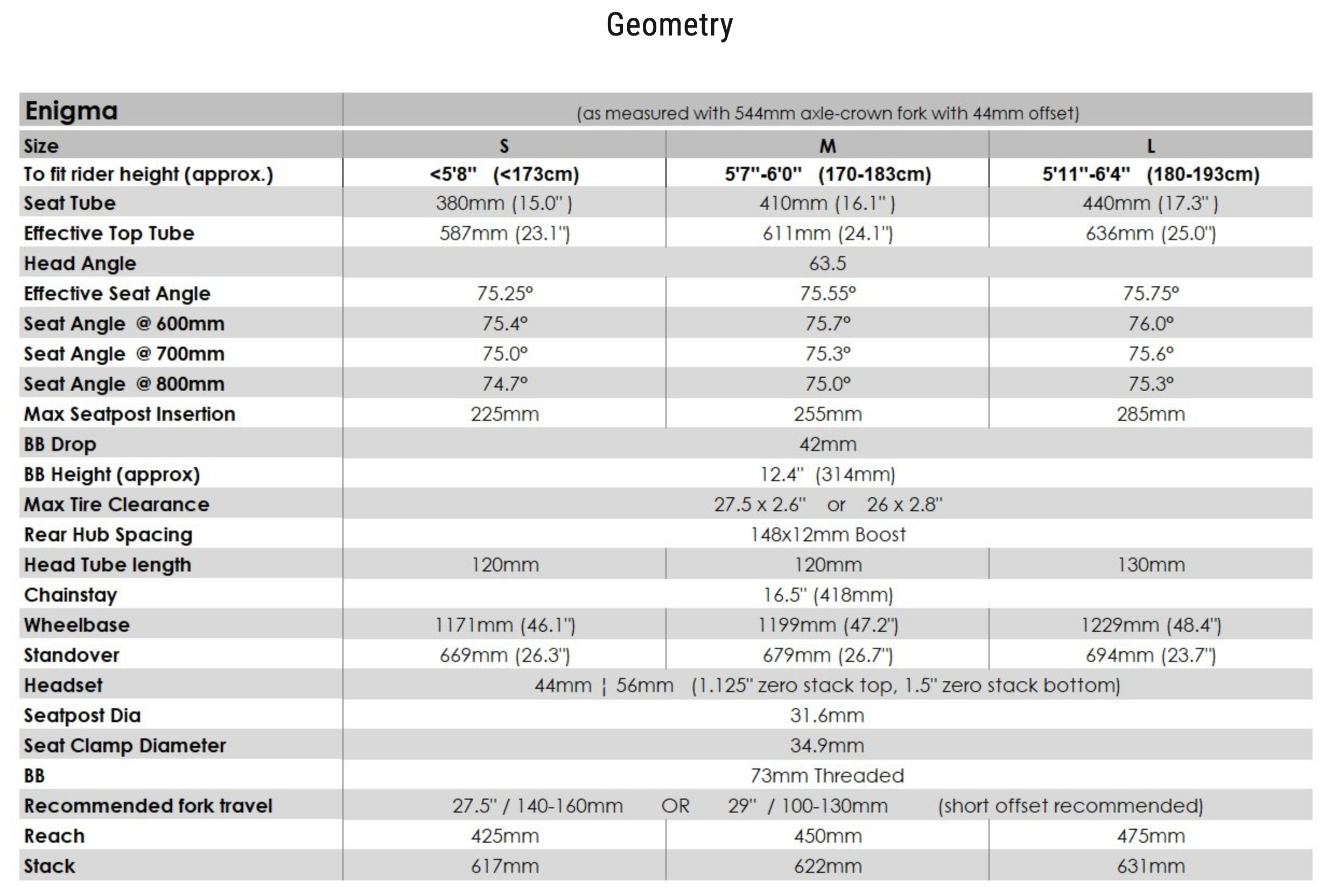
I thought I’d narrowed it down, possibly to a Radical Bicycle Co. Grim Ripper – lovely looking bikes, and a locally-owned company, but the reach figures were just a hair long for my tastes. Then one day, while watching some videos by Hardtail Party, I came across the Banshee Enigma and was immediately smitten on its apparent playful nature and thoughtful design language. Further complimentary words from a writer who’s opinion I truly respect, Andrew Major (formerly NSMB, now MEATengines), and I was well and truly sold.
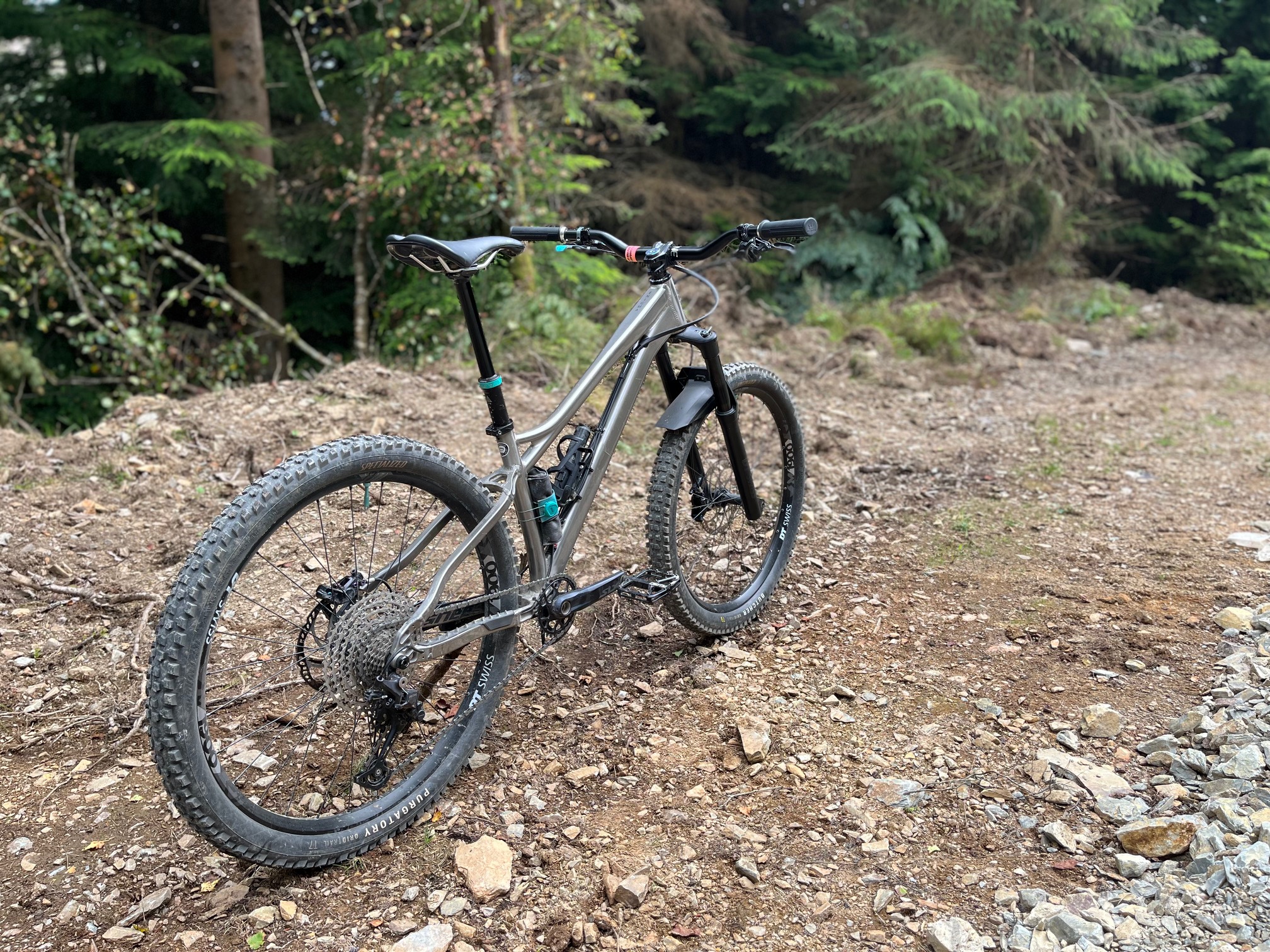
Frame decided upon, the build spec was then guided by a combination of personal preferences, parts I had on hand, and a dash of min-maxing…
Min-maxing can [also] refer to making optimal choices in [other] situations, such as making the most of your time with the most impactful results
Frame
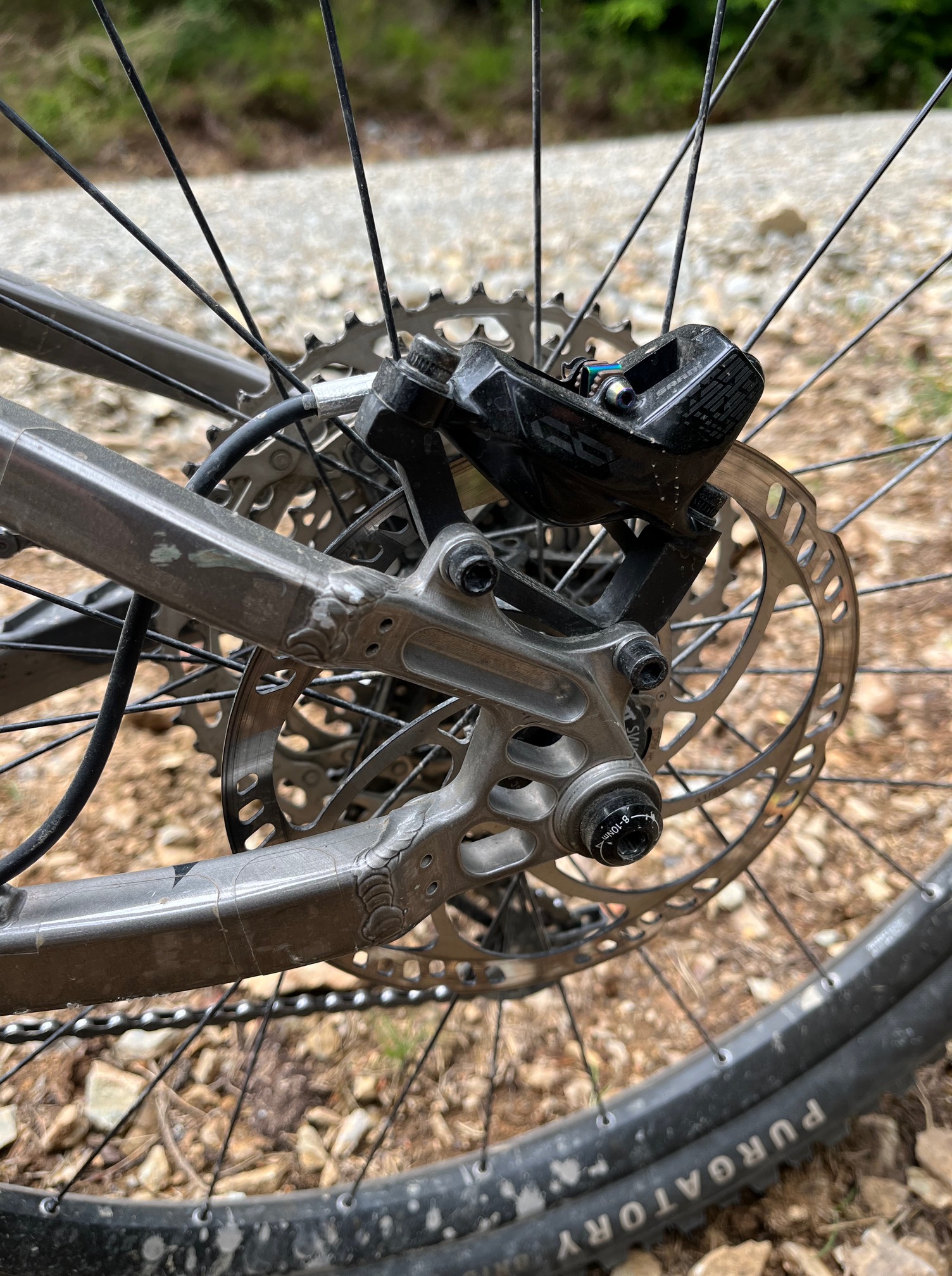
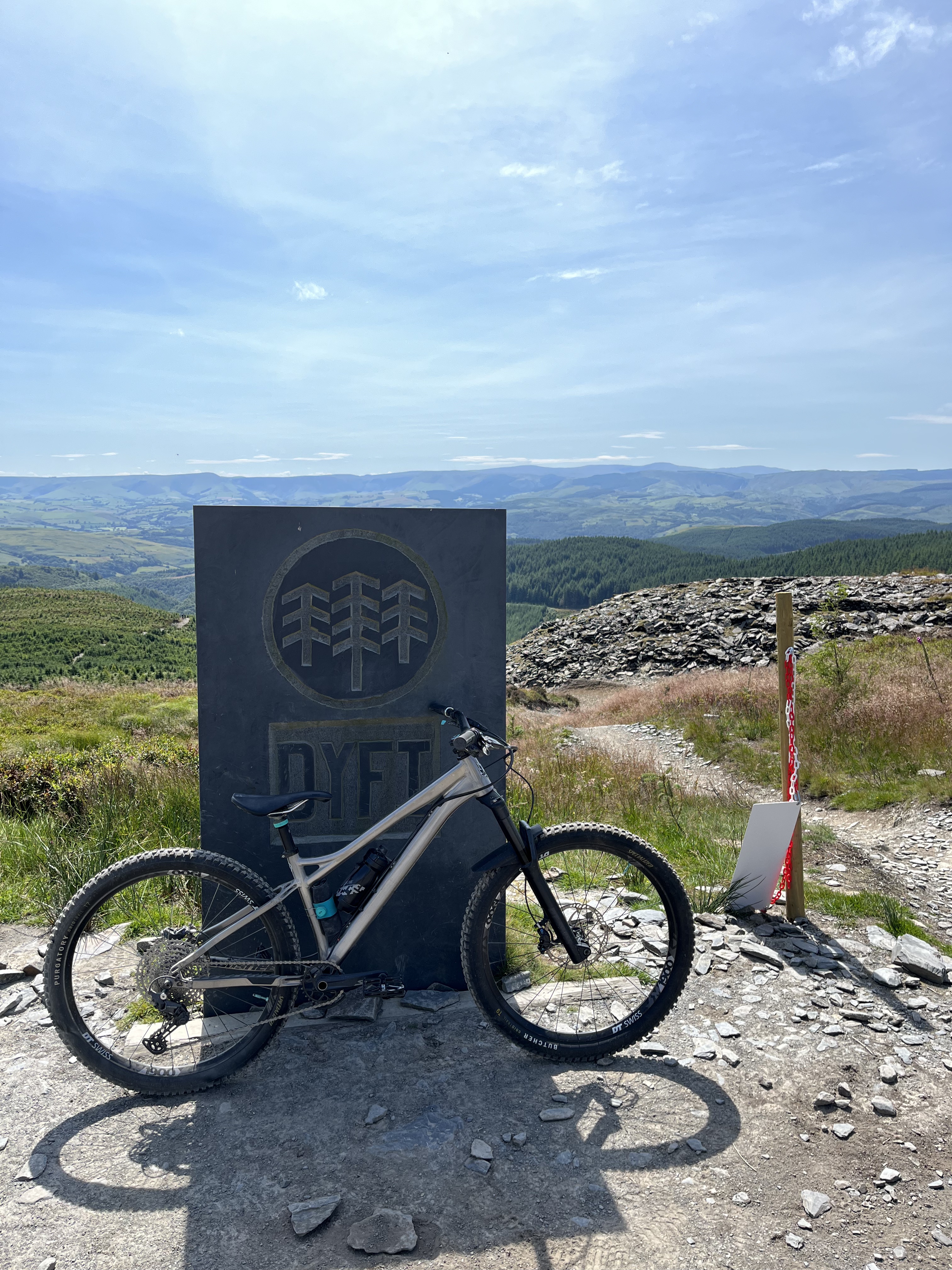
So, the frame I settled on is an Enigma in size small. I think Banshee’s sizing/geometry chart for this model is quite conservative and I could definitely ride a medium at my height (I’m right on the cusp of the two sizes), but as I’ve previously discussed, I find smaller bikes more fun. Getting this thing in the stand to build it up was a real treat – the frame has some lovely details, like the intricately-CNC’d chainstay/seatstay yokes and dropouts which are designed to add compliance to the rear end, and the awesomely swoopy hydroformed tubes – the top tube is particularly cool. Cable routing is fully external, which I love, except for the shifter cable running through the chainstay… which I am ok with. The bike looks great overall, with minimal branding to interfere with the clean aesthetic and raw finish – I’ve wrapped the frame in off-cuts of invisiFrame to try to keep it looking fresh. Headset is the stock unit that comes with the frame.
Wheels & Tyres
The Enigma can be run either full 27.5″ or as a mullet. As also previously discussed, I have a penchant for little wheels, so it was an easy choice for me. I had a set of older DT Swiss M1900s on hand, which I treated to a bearing overhaul and Ratchet LN upgrade kit in 36T flavour and they were ready to go. With a strong, wide rim (30mm internal) and reliable hubs, they’re great wheels for the price, especially the newer Ratchet LN versions. Rubber is Specialized because they are bonkers value and legitimately great tyres – a 2.6″ Butcher T9 up front and a 2.4″ Purgatory T7 out back are a pretty great combo for most conditions, and the Grid Trail casing is robust enough for my uses. MucOff valves are as good as any and add some colour-matched bling – they’ll get upgraded with Schwalbe Clik valve cores once I can get my hands on some more.
UPDATE: Valves have now been Clik-ed. I really love these things and will eventually write about them…

Suspension
Unusually, DT Swiss also take care of suspension duties up front. I’m running a first-generation F535 ONE fork, with 140mm travel (perfect travel for most non-XC hardtail duties). You see very few of them around, but I really like this fork – its little hybrid coil arrangement means it’s supple off the top, but really supportive and likes to sit up high in its travel, helping to limit the dynamic geometry changes you experience on a hardtail. The design is very clean – setup is a little fiddly at first, but DT Swiss’ recommended settings are almost bang-on and the fork really does feel “set and forget”. There’s also a small bolt-on fender which does just fine at repelling moderate muck and while I sometimes wish for something longer in cruddy conditions, I can never be bothered to swap.
Drivetrain
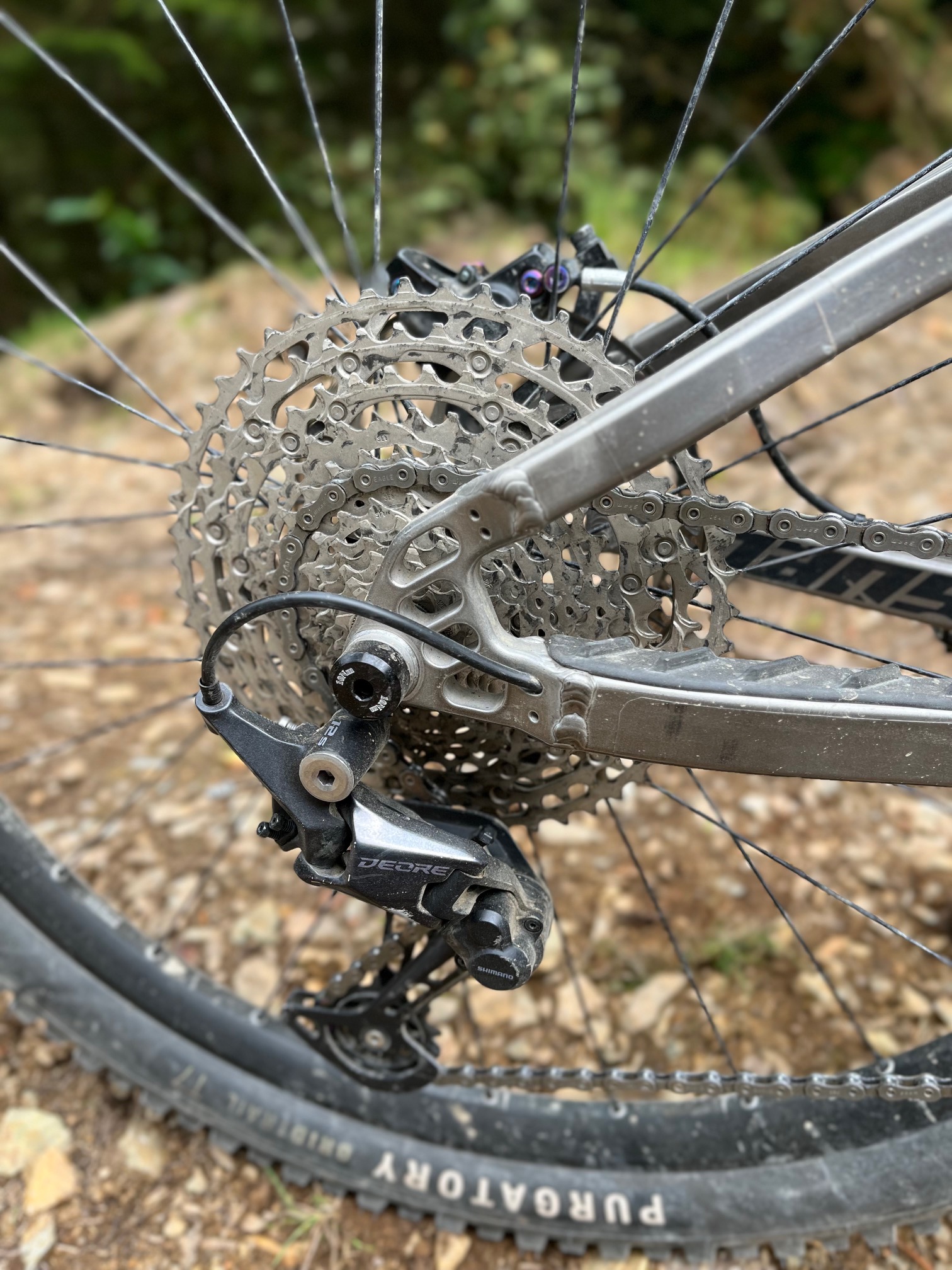
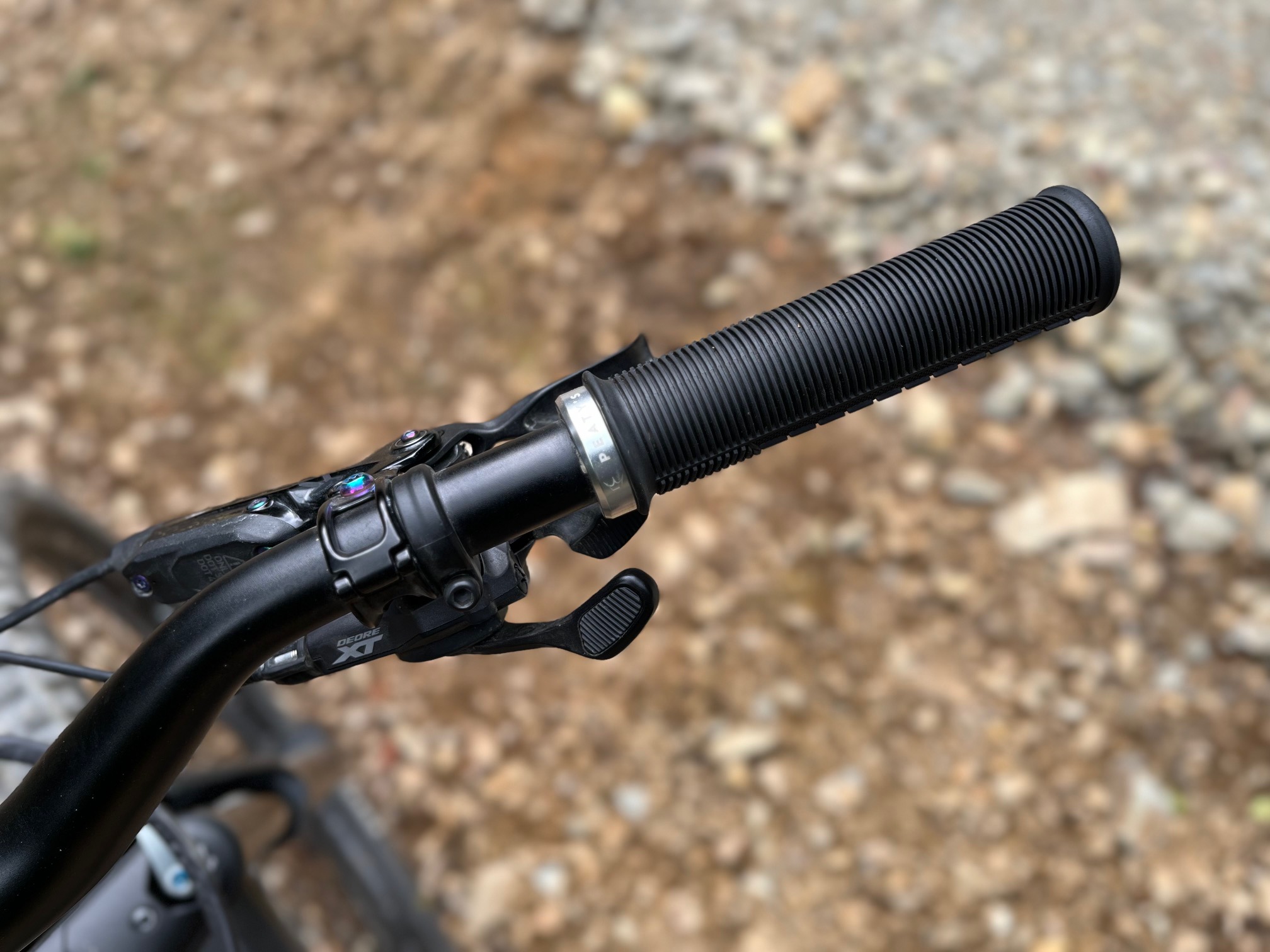
Some might say the drivetrain is min-maxed; others might say it’s a mish-mash. Derailleur and cassette are Shimano Deore 12-speed, because they’re functionally almost indistinguishable from the higher-end stuff, wear well and are cheap(er) to replace. The shifter sees an upgrade to XT, because I like the robust feel and multiple trigger shifts. The crankset is SLX level, because honestly it looks nicer than the Deore one, but beyond that it’s diminishing returns. The 30T Works Components alloy chainring also just looks nicer to my eye than the riveted Shimano ones, and the whole thing spins on a no-nonsense Shimano XT-level bottom bracket. Unite Co. provide a little ISCG05 bash guard.
The chain proved to be problematic at first. I initially ran with a box-fresh Shimano Deore, but it was noisy towards the top of the cassette, even when immaculately clean and well-lubricated. Swapping to a broken-in XT chain did nothing to help. Out of exasperation I tried fitting a SRAM NX Eagle chain, and this quietened things down considerably. I believe the issue is that the Shimano chain is fractionally narrower and possibly less laterally flexible, and this doesn’t play well with the Enigma’s crazy short 418mm chainstays and resulting chain line – it will still drop down the cassette if back-pedalled excessively in the lowest couple of gears. NX chains like to rust at the first sign of water, so after winter it’ll probably get swapped out for an X01.
UPDATE: After a road trip left the NX chain particularly grim, I swapped that old broken-in XT chain on as a stop-gap. To my surprise, the bike is somewhat quieter now, although it still doesn’t enjoy backpedalling. My best guess is that some, but not all, of the initial drivetrain noise was due to the crisp new Works chainring needing to wear in a little.
Brakes
Stopping was initially taken care of with a set of Shimano Deore four-pots, which lasted one ride before they began pissing mineral oil, at which point I decided I had finally had enough of inconsistent and unreliable Shimano brakes.
I’ve been critical of SRAM brakes in the past, having had mediocre experiences with Code Rs and Guides, but the Code RSCs are actually really great. They’re plenty powerful for a trail bike, modulate their power well, are nicely adjustable to fit most hands, and are relatively easy to live with. Definitely worth spending the extra money on, and not just for the fancy rainbow hardware. Thicker rotors improve the feel of Codes quite a lot, so I fitted a set of 2.0mm Magura discs – 203mm front, 180mm rear. Pads are stock SRAM sintered.
Levers are wound in to be fairly close to the bars, and bite point is set as far out as possible. The resulting setup feels consistent and unwavering, with a firm grab right where I want it and a predictable but quick ramp up in power.
Contact Points & Finishing Kit
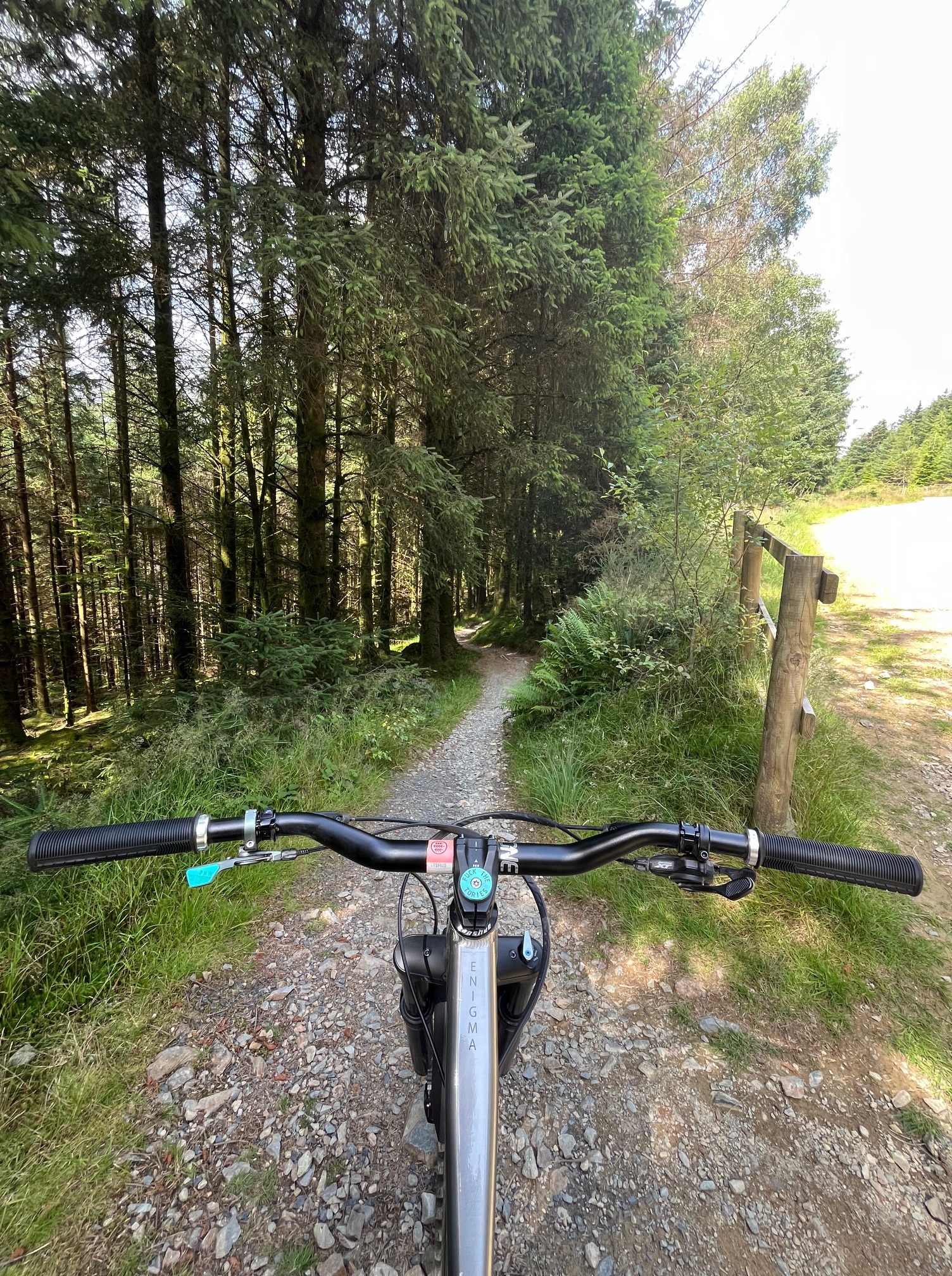
My wrists have grown to love the exaggerated back-sweep of the Junker handlebars on my Mk6, so I wanted something similar but maybe slightly less wild here. Stooge came through again with their Moto Bars – with a 17 degree backsweep, 38mm rise, and 31.8mm clamp bore (comfort!), they’re pretty much bang-on. I cut them to 770mm as with all of my bars except the Junkers. 31.8mm bore stems are less common these days, but I picked up a PNW Range Stem in 40mm length, which turned out to be nicely matchy-matchy with the rest of the finishing kit…
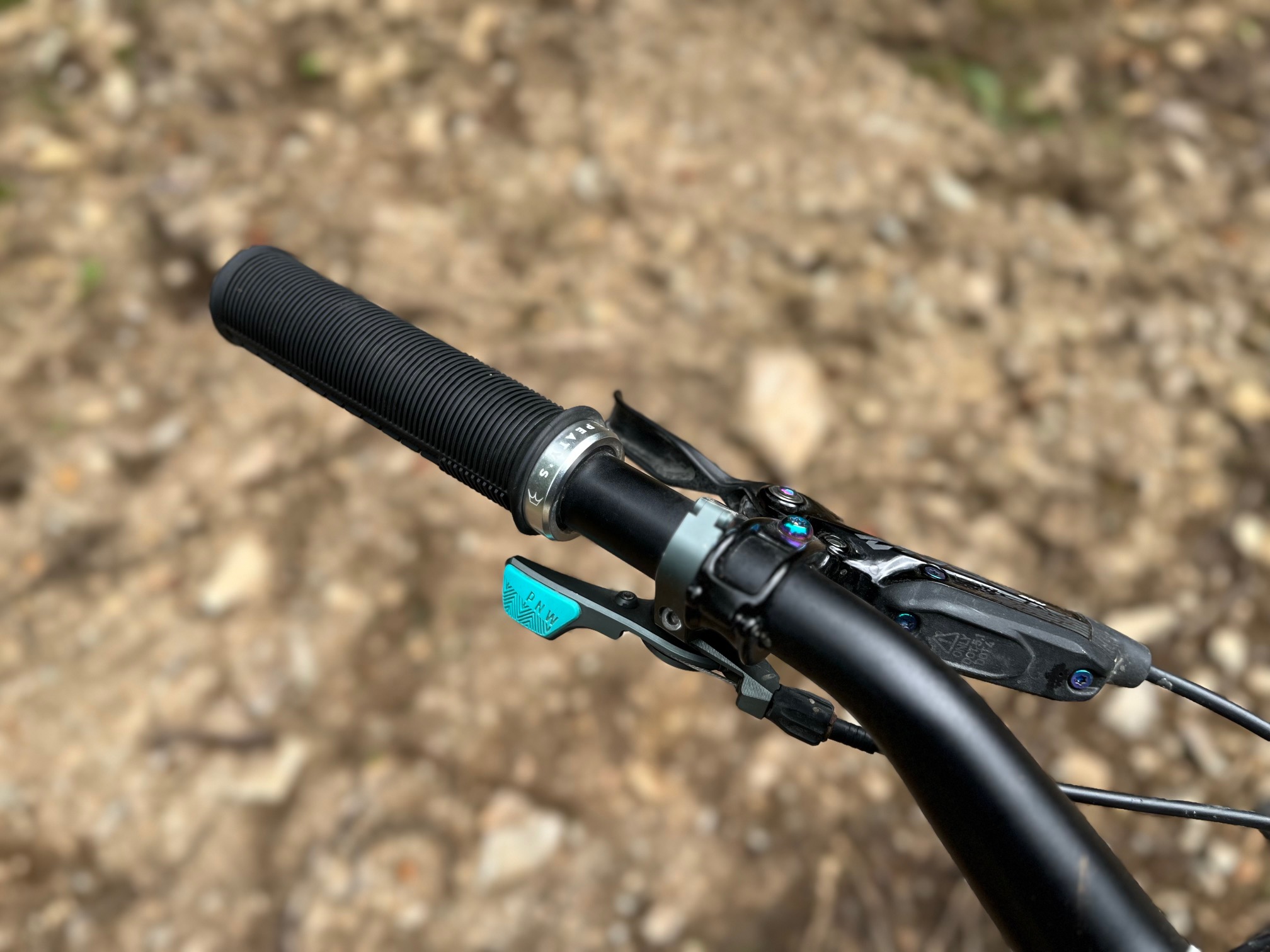
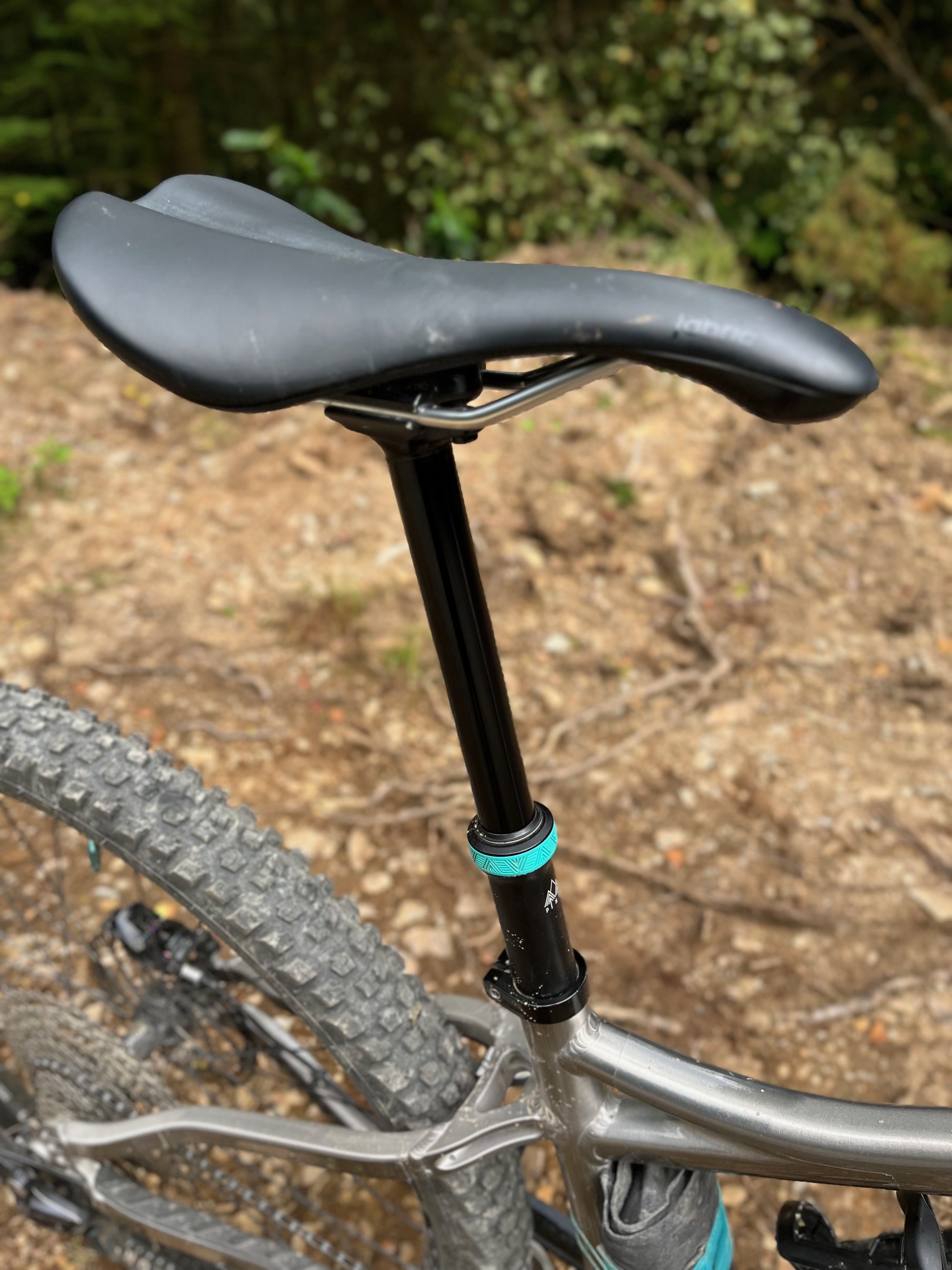
Sitting pretty on my bars is the same trusty PNW Loam Lever that I’ve had on probably five different bikes at this point. It’s still my favourite lever ever, ergonomically and aesthetically, and it’s got turquoise on it so you can’t go wrong. I deviated from my usual go-to OneUp and thought I’d try a PNW Loam Dropper in 170mm length – look ma, more turquoise! It runs smooth and solid, with very little rotational play, nice actuation and it gives decent (if not class-leading) drop for the length. Atop this sits a Fabric Scoop saddle of some sort – this one is slightly different from the one on my Mk6, but they’re cheap and it still fits better than any other saddle I’ve tried recently.
Grip duty was initially taken care of by a set of DMR push-ons (glued and wired, of course) but when Peaty’s released their Monarch lock-ons in the summer I decided to give them a go. The mushroom Monarchs are some of the best lock-ons I’ve used, up there with my favourite ODI Longneck V2s – they’re a nice size and shape, and both compound and texture make them very grippy. They’re decently comfortable for lock-ons, too.
UPDATE: I’ve since reverted back to push-ons because as good as the Peaty’s grips are, they’re still not push-ons!
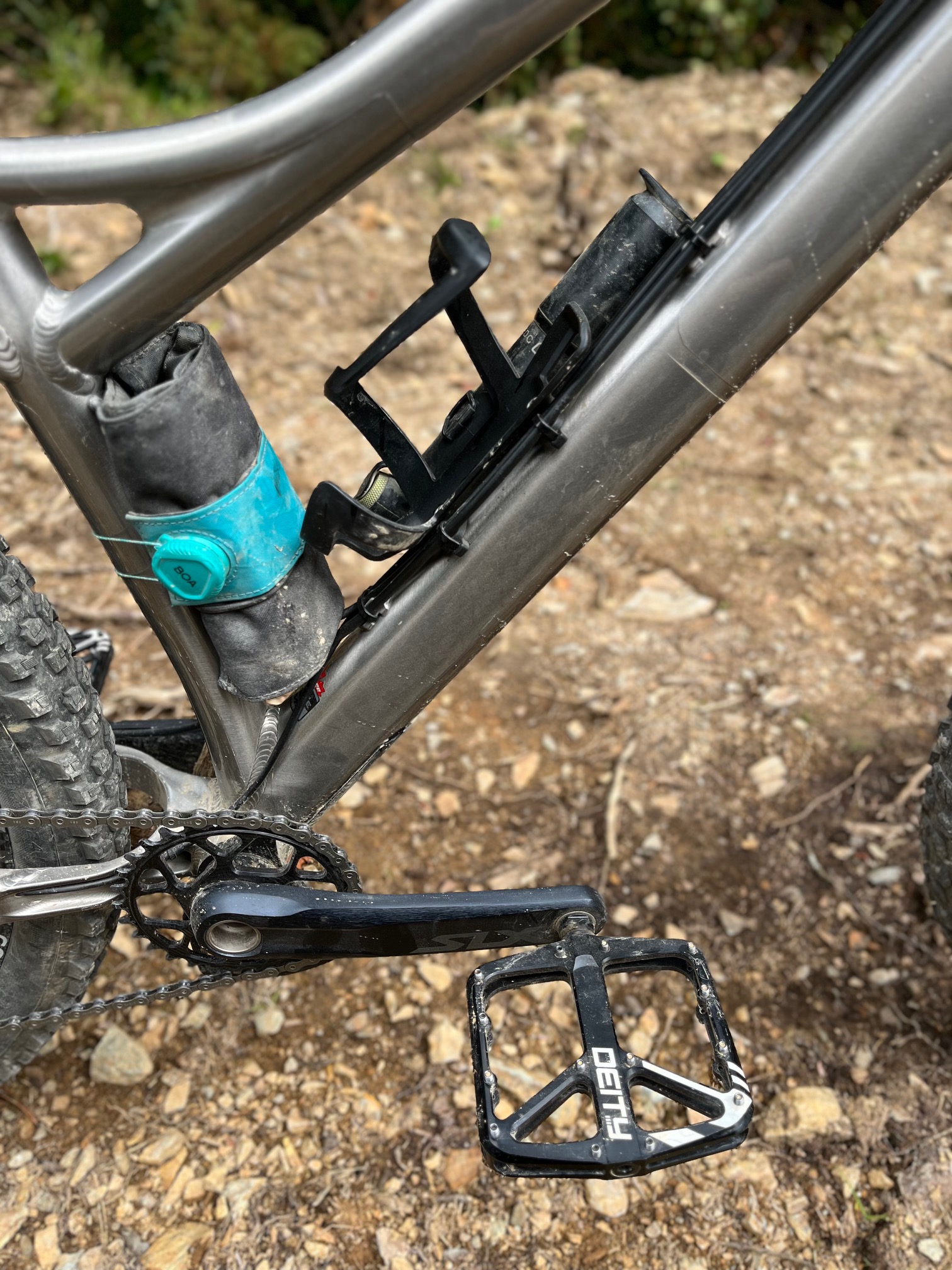
I picked up a set of the Deity Supervillain pedals as soon as they were released and holy shit, are they good – a big platform with a great overall shape and really grippy pins, and I’m sure they’ll last forever. I still have a soft spot (on my shins) for my Burgtec Penthouse Mk4s but the Supervillains definitely have them beat for outright grip, especially when paired with a good sticky shoe like my current Specialized 2FOs.
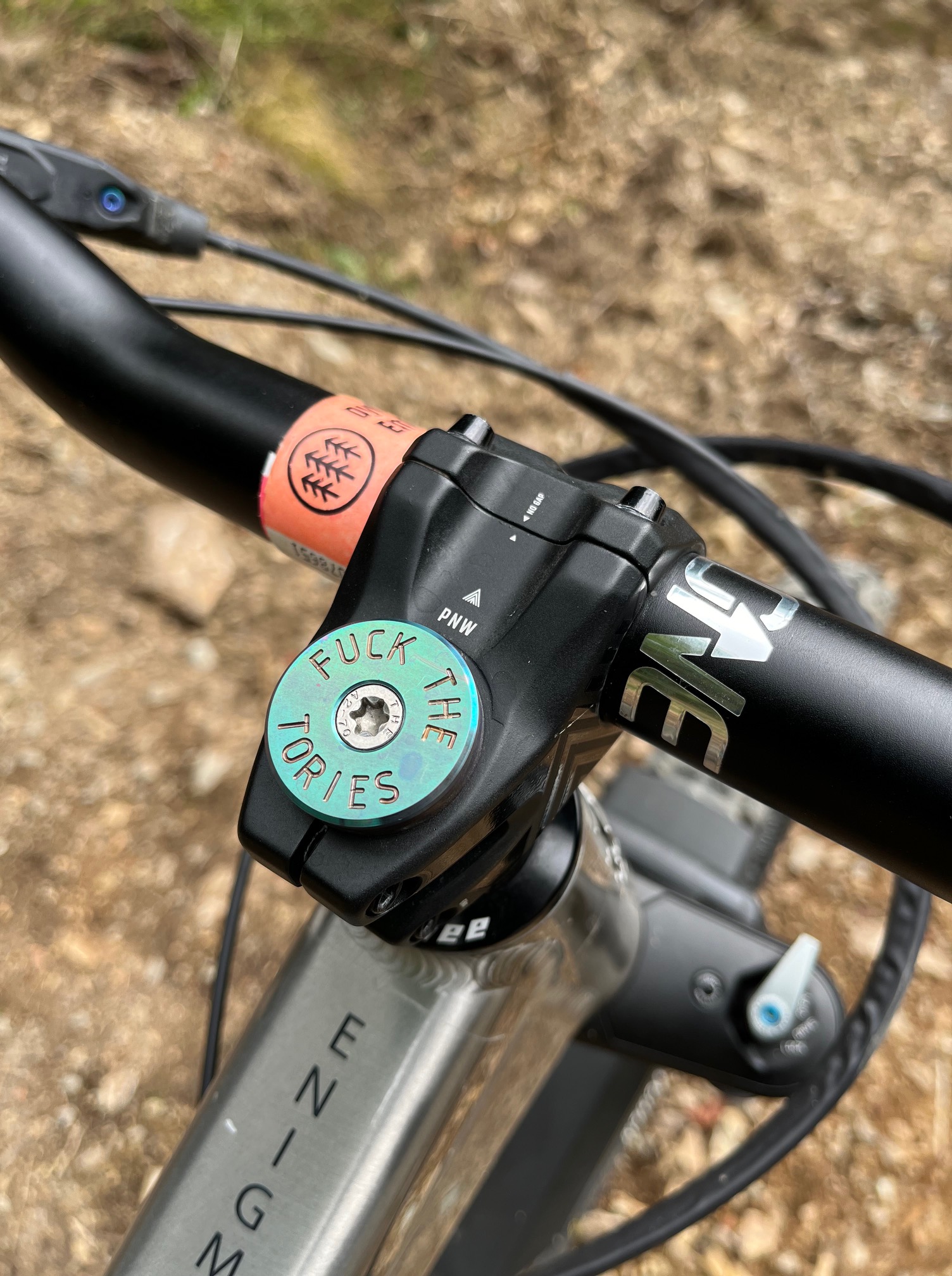
From there it’s just down to the little details, really. My favourite mildly-offensive Ti Bentley Components stem top cap has made it across here (and it matches the colour scheme). Cables and hoses are heat-shrink-wrapped and clipped for neatness – tidy cables are a sign of an attentive, proud mechanic. A side-loading Specialized Zee cage lets me squeeze a mid-sized bottle into a very compact frame, and there’s a bracket for my trusty OneUp EDC Pump and Tool combo. An old Rapha tool roll holds a spare tube and some odds and ends, held in place by a posh (and very turquoise!) Occam Designs Apex Strap.
Thoughts & Impressions
So after all that, do I actually like the bike?
Yes, I most certainly do. Turns out, years of accumulated knowledge and stubborn preferences actually makes a difference – I love this bike! It is FUN. It’s not much of an exaggeration to say it rides almost like a dirt jumper, with its short reach and even shorter back end, but with real tyres and a proper fork. It brings mellower trails to life, but its slack head angle and relatively tall stack means you can still push it on steeper or rougher terrain (it was a riot at Dyfi Bike Park). The frame feels taut and efficient without being harsh – you don’t noticeably feel it, but no doubt those fancy engineered yokes and dropouts do tame trail chatter a bit. It climbs decently, too, as long as you’re careful to weight the front end – that short rear centre means the front wheel likes to lift on steep gradients.
No, it doesn’t have the rollover of 29″ wheels or the confidence of a massive reach and long chainstays, but that’s not the point. There are lots of bikes out there with those traits, but 99% of them miss out on whatever special sauce Banshee cooked into the Enigma. Its inherent nature means this bike simply won’t be to everyone’s tastes, and that’s totally ok.
Is there anything I personally don’t like about it? I appreciate the external cable routing but it does clash with the bottle cage bosses. You could always add a little stand-off between the frame and the cage (something like a Presta valve lock nut), but I would argue you shouldn’t have to. I used cable ties to tuck the hose/cables around my pump bracket. The handsome tinted clear-coat is also very fragile – despite careful handling, I’d somehow chipped it before I’d even got the bike into the workstand. Banshee do provide a bottle of touch-up paint with the frame, but be prepared to protect the finish before doing anything else. I also found bash guard setup fiddly – ISCG05 tabs are located on a (replaceable) splined spacer which fits around the BB shell, but clocking this for optimum alignment took a few tries. At least I only had to do this once. Finally, the drivetrain noise/chainline issues I encountered were frustrating, but I’d need to test the frame with other groupsets to see if it’s just down to my setup, or an issue caused by the frame design and geometry.
These minor inconveniences do little to tarnish this bike for me, though. Going back to my first thoughts, if I only have limited opportunities to ride then I want each of those opportunities to remind me why I love mountain biking, no matter where I’m riding. This peppy little bike from Canada does exactly that.
To end back on that riddle:
“The less of them you have, the more one is worth.”
Friends? Bikes? Rides? Maybe this Enigma has more than one solution…
 Ranting Wrench
One response to “Riddle Me This: Banshee Enigma”
[…] are now Shimano Deore. The only reason for this is that the original SLXs feel more at home on my Enigma, […]
LikeLike